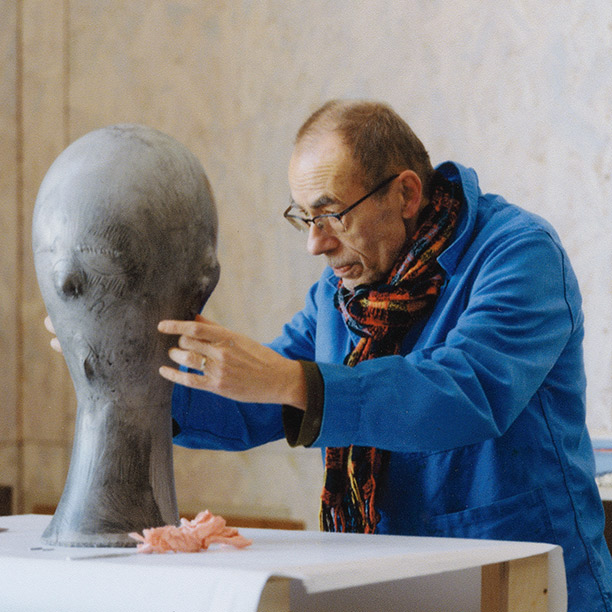
I don’t care about the form; what counts is the experience, how to make it accessible again, to make an event of it. To do that, you have to be able to bring the visitor to a standstill, to move them. When they leave, they can begin to build on that emotion. […] this is where the piece exists. I try to make it reveal itself when the viewer needs it.
— Jean-Luc Moulène
Jean-Luc Moulène, a self-declared technicien libertaire, creates work that is stylistically ambulatory yet bounded by specific conceptual parameters: it must be separate and complete in itself; make clear the conditions under which it was produced; and establish a direct link with that from which it has been separated—which is to say, the world. His practice cuts diagonally across the oft-stratified spheres of economics, politics, and culture in order to reveal gaps in assumed knowledge and allow new figures and transparencies to emerge. Unlike a scientist or a mathematician, an artist must produce work that is not merely the outcome of an experiment, but must also render the experiment available to others; Moulène sees this as his task. The resulting forms are models for other lines of inquiry.
While his ‘objects’ and ‘images’ take three-dimensional materials and photography as their respective supports, they are not expressly sculptures or photographs. “I consider my images and objects as tools, articles of use: practical above all else,” Moulène emphasizes. He is not interested in occupying the symbolic position of the author, but rather, sees the role of the artist as one of authorization.
read more


jlmoulene_mag_2019_install_05-2
Jean-Luc Moulène (b. 1955, Reims, France) studied Aesthetics and Sciences of Art at the Sorbonne University in Paris. He lives and works in Normandy. Among the institutions that have dedicated solo exhibitions to his work are MONA – Museum of Old and New Art, Hobart, Tasmania (2023–24); Casa São Roque Centro de Arte, Porto (2021); SculptureCenter, New York (2019); Secession, Vienna (2017); Centre Pompidou, Paris (2016-2017); Villa Medici, Rome (2015); Kunstverein Hannover (2014); Dia:Beacon, New York (2012); Carré d’art-Musée d’art contemporain, Nîmes (2009); Culturgest, Lisbon (2007); Musée du Louvre, Paris (2005); and Centre d’Art Contemporain de Genève (2003). Moulène has participated in the Venice Biennial (2019, 2003); the Taipei Biennial (2016, 2004); the Sharjah Biennial (2010); the First International Biennial of the Image (Laos, 2007); the Sao Paulo Biennial (2002); and Documenta X (1997). His work has been included in major group exhibitions at Hayward Gallery (London); MoMA PS1 (New York); Centre de la photographie, Genève; Miejski Osrodek Sztuki (Gorzów, Poland), S.M.A.K. (Ghent, Belgium); MMOMA (Moscow); Museo Universitario Arte Contemporáneo (Mexico City); Museo Tamayo (Mexico City); Guggenheim Museum Bilbao; Palais de Tokyo (Paris); Punta Della Dogana (Venice); WIELS Contemporary Art Centre (Brussels); Witte de With (Rotterdam); ARC / Musée d’Art Moderne de la Ville de Paris; Grey Art Gallery (New York); Yokohama Museum of Art; Triennale de Milano; KW Institute for Contemporary Art (Berlin); Museum Ludwig (Cologne); De Appel (Amsterdam); Grand Palais (Paris); Kunstverein Nürnberg, and elsewhere.
Moulène’s work is held in the collections of the Museum of Modern Art (New York); Tate (London); Museum of Contemporary Art (Los Angeles); Dia Art Foundation (New York); Walker Art Center (Minneapolis); Serralves Museum (Porto); Musée d’art moderne de la ville de Paris; Tel Aviv Museum of Art; Pinault Collection; Centre National des Arts Plastiques (Paris), among others. Monographs dedicated to his work include Jean-Luc Moulène and Teams (MONA – Museum of Old and New Art, 2023), Breves (Secession/Revolver Press, 2017), Jean-Luc Moulène (Centre Pompidou/Editions Dilecta, 2016), Jean-Luc Moulène: Documents, 1999-2016 (Sequence Press, 2016), Jean-Luc Moulène: Disjonctions, Opus & Documents, Il Était Une Fois (Verlag Für Moderne Kunst, 2015), Opus + One (Yale University Press and Dia Art Foundation, 2012), Jean-Luc Moulène (Walther König, 2009). Other books on his work include Matter and Form: Self-evidence and Surprise: On Jean-Luc Moulène’s Objects by Alain Badiou (Sequence Press, 2019), “Untitled,” in Collapse vol. VIII, edited by Robin Mackay, (Urbanomic, 2014), and Torture Concrete: Jean-Luc Moulène and the Protocol of Abstraction by Reza Negarestani (Sequence Press, 2014).
Moulène’s recent solo exhibitions include Jean-Luc Moulène, Miguel Abreu Gallery, New York (2025); Enlightenments, Thomas Dane Gallery, Naples (2024); Jean-Luc Moulène and Teams, MONA – Museum of Old and New Art, Hobart, Tasmania (2023–24); Le point le puits le plein et la pluie, Galerie Chantal Crousel, Paris (2023); Clearly, Miguel Abreu Gallery, New York (2022); and Técnico Libertário, Casa São Roque Centro de Arte, Porto, Portugal (2021–22).
Publications