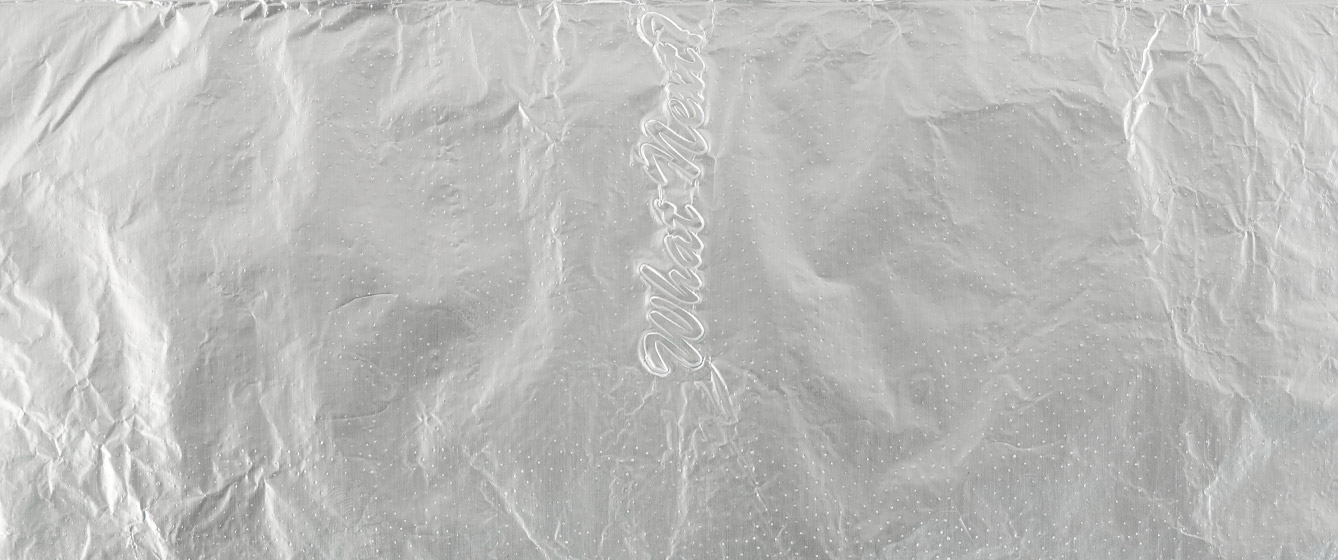
Miguel Abreu Gallery is pleased to announce the opening, on Friday, January 24th of Flint Jamison’s third and fourth exhibitions at the gallery. Class: Weight will be held at 88 Eldridge Street, and Installation View at 36 Orchard Street.
As the artist writes: My presentation of new work is comprised of three aspects over two exhibitions.
1. For Class: Weight I began by posing a question to the gallery stakeholders: Does the organization’s database allow for the tracking of the weight of artworks? The answer was no.
The gallery uses a popular third-party inventory software called Artlogic. I further asked whether it would be possible to simply add a category for weight in each of the works’ main entry. The answer again was no.
The lack of data concerning an artwork’s weight is surprising, as weight is one of the key considerations in their transport. I believe that there are two different uses of the term “transport” concerning an art gallery’s interface with the property they tender, one literal and the other abstract, or figurative. One definition relates directly to capital. Artworks, mine included, are matter of fact, efficient instruments of the circulation of capital. In this relation to transport, the category of the work’s weight is rarely accounted for. When it comes to the mobility of objects, however, one often finds data about an object’s heft. In the Shipping section of an Artlogic entry there are fields for a work’s weight as well as packed weight. It is a functional aspect of categorization that marries weight specifically to an object’s potential movement.[1]
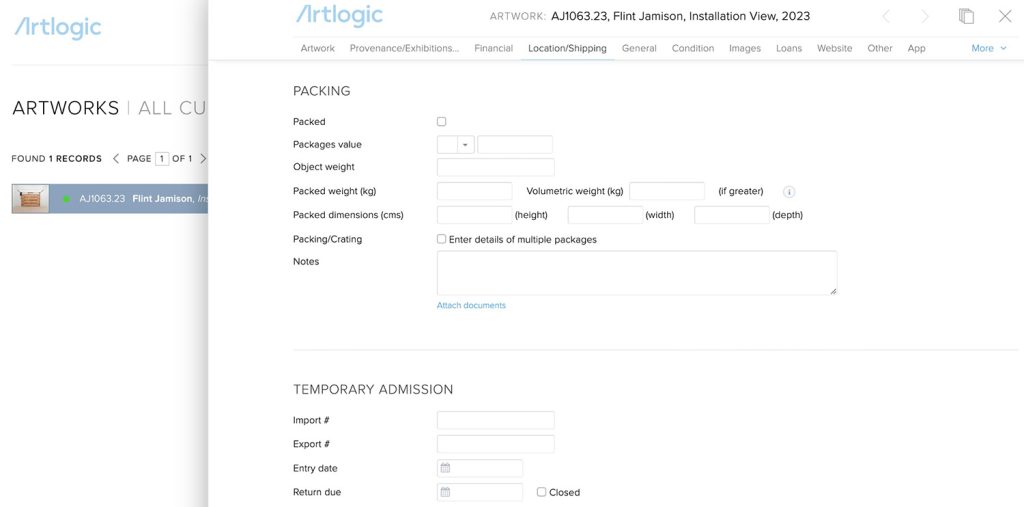
The distinct uses of these definitions of transport are not unrelated, although this exhibition endeavors to distinguish the abstraction of the former from the actual weight of the property artists produce.
Despite their penchant for motion, a thing that artworks do, more often than not, is rest: on walls, on grounds and in storage spaces. What is vertical and what is horizontal is typically representative of the transport of perceived value. Weight itself is usually omitted or specific only to the object’s relative proximity to another location. As sculptures become images that exist on servers, what we also find obscured is the energy expended to serve us this information. What is the weight of all these hyper images?
In Class: Weight, there is a lot of movement, or pointing to movement. There are scales; there are the humming ghosts of transport that act as infrastructure for the transportation of capital itself. Maintaining the works and their movement remains vital. A maintenance manual is available as ephemera for visitors.
In a unique kinetic dance, certain objects in Class: Weight pay homage to absent, and therefore weightless 2D works. These invisible pictures are staged at an ideal viewing height by the movement up and down of shelf sculptures cycling through more or less renowned art collections, such as the Gurlitt Collection partially looted by Hildebrand Gurlitt, one of Hitler’s and Göring’s primary art dealers, or a group of student and faculty works housed in the Jacob Lawrence Collection at the University of Washington in Seattle, the ownership status of which remains unclear.
2. For Installation View, presented at 36 Orchard Street, I have asked poet, artist and organizer Tim Johnson to respond to the works in the show and their site of display.
Notes on Installation View for Flint Jamison
‘Tis the gift to be simple, ‘tis the gift to be free
‘Tis the gift to come down where we ought to be,
And when we find ourselves in the place just right,
‘Twill be in the valley of love and delight.
When true simplicity is gained,
To bow and to bend we shan’t be ashamed,
To turn, turn will be our delight,
Till by turning, turning we come ‘round right.
—“Simple Gifts” (1848), Elder Joseph Brackett
In times of national strife, America turns to the Shakers. Or so a friend told me last year, in the lead up to the US national elections. It resonated, but uncomfortably. On further conversation, the same friend directed me to William D. Moore’s Shaker Fever: America’s Twentieth-Century Fascination with a Communitarian Sect, a very informative book that outlines the period, 1925–1965, during which the Shakers came to ‘personify’ the “nation’s finest qualities of piety, ingenuity, simplicity, sobriety and self-denial.” By existing outside the mainstream, Moore argues, and yet within the trajectory of American colonial history, the Shakers “paradoxically…serve as both icons of Americanism and as critiques of national shortcomings.” The paradox helped to reaffirm the persistence of America’s finest qualities, in the new light of industrial modernism. The paradox breaks down, or possibly multiplies, when one sees how the Shaker example was concurrently used to support causes as diverse and contradictory as American exceptionalism, entrepreneurialism, feminism, craft-communalism and the abolition of private property.
What bothered me about the turn that Moore and my friend address is not the articulation of the nation’s finest qualities, or even the arguments on behalf of American exceptionalism, but rather the argument to make the Shakers nationally constitutive, and the resemblance of those arguments to the familiar rhetoric of “a few bad apples,” which spoil the police force. In the case of the Shakers, of course, we’re not talking about the bad, but rather the good, or even very good apples, which show just how pious and hard-working the nation is, at its core, and how, despite the bad apples, the core is still worth defending, regardless of what it does or has done. It’s as if Tom Joad might negate political reality by saying, “Think of a chair, whenever there’s a fight, so hungry people can eat, and it’ll be there.”
I thought of this adage about the Shakers and national strife when Flint asked me to write something for his upcoming exhibition, where he will present a garage door, an entertainment center and speaker housings, all made from carefully cut, sanded and assembled pieces of beetle-bored lumber. He sent me photos of the work in progress and again, it resonated, but uncomfortably. What are those bore-holes doing there? Oh, they’re the result of an invasive species. Flint later told me an art shipper initially declined to transport the work for fear of what the bore-holes might indicate. As to whether the perceived liability which prevented them from accepting the shipment was related to concerns over structural integrity, an unacceptable increase in precarious value, archival uncertainty, or the danger of infection to the shipper’s other goods of transport, the shipper was vague. In the nation of finest qualities, it’s hard to say. What’s clear is that Flint’s work speaks to domestic and boundary conditions long permeated by fears of foreign agents, themselves potentially masking deeper fears that what’s foreign in the wood might not be so stable or foreign.
Acquiring Shaker goods, the story goes, you furnish your house with the nation’s finest qualities. If you can’t pay for piety or ingenuity, whole industries have developed to distribute them more affordably in products as diverse as soap and salsa. Since 1965, the fever you catch is usually secular Shakerism. Despite the update, or rebranding, there remains something in the colonial etiology that a new name cannot make right, but which an attempt to produce a more accurate historical context might help to clarify. I’ll admit, there’s still so much work to do, only it might not be the work we have in mind.
available at the gallery
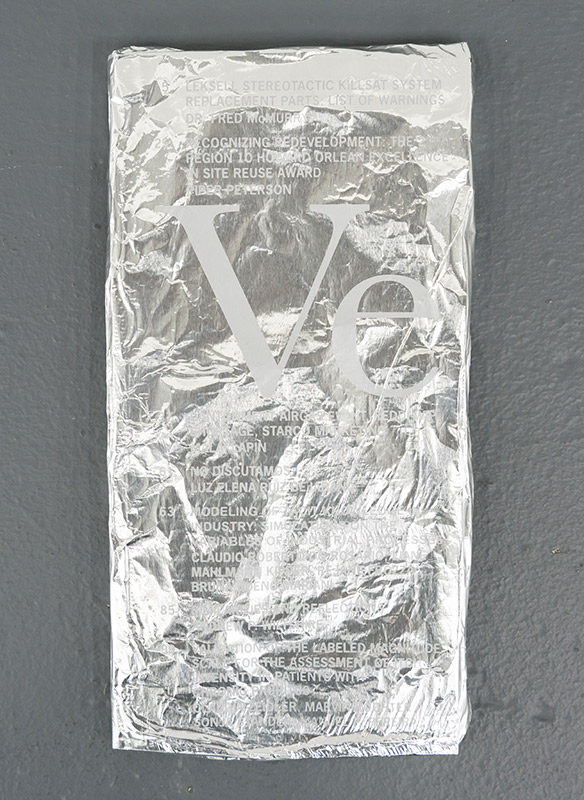
3. Finally, I have produced issue 13/18 of Veneer Magazine. A dozen material stocks are used and five different printing methods have been deployed in its production. Katherine Pickard, publisher at Sequence Press and Managing Editor of Veneer, introduces this issue of the serial publication:
From handmade to mechanized, from the body to the shop, the code makers are the code breakers—this circuit is closed. Handpicked, letterpressed, offset, inkjet, silkscreened, foil stamped, spiral bound, soup to nuts. Artist as editor, publisher, materials hoarder and printer. Beatrix Potter’s Victorian journal beckons a dedicated decipherer; a neurosurgeon’s manual cautions technicians before imaging; a sheet of music by Juan Gabriel sets the tune for a bittersweet plea; and a North American gas producer leaves holiday gluttons and the nitrous galaxy clamoring. Primary sources are placed before us as documentary guidance. Warnings—from our elders and our experts—are directions for the preservation of our bodies and the earth. Veneer 13 sticks to the science for us to ponder: What Next?
Consistent with my old interest in the means of production underlying the creation of artworks, I have attended to as much myself as possible to bring this exhibition to fruition. As is evident here, I have also tended to the modes of communication, editions, and ephemera associated with the show and publication. The works incorporate materials such as a fir repurposed from the Puget Sound with the residue of invasive worms, full range drivers, organza, photographs, linear actuators, garage door hardware, vibrators, power stations, steel, aluminum, foil, rubber, replica titanium hardware, various controllers, and paper. Again, each work requires regular maintenance.
Flint Jamison (b. 1979, Billings, MT) had his last presentation at Miguel Abreu Gallery in 2017. Since, he has had solo exhibitions at Kunst Halle Sankt Gallen, Galerie Max Mayer, Düsseldorf, Air de Paris, Künstlerhaus Stuttgart, as well as small-scale shows at Paid, Seattle and Marfa Book Co. in Marfa, TX. He has also produced numerous artist books; and as a co-founder of Yale Union in Portland, OR, lead the effort of the building’s rematriation to the Native Arts and Cultures Foundation in 2021.
Jamison’s work is held in numerous public collections, including the Whitney Museum of American Art, New York; the Centre Pompidou, Paris; the Art Institute of Chicago; the Museum of Modern Art, New York; the Rijksakademie, Amsterdam; the Walker Art Center, Minneapolis; the Henry Art Gallery, Seattle; the Allen Memorial Art Museum, Oberlin; and the Princeton University Library, among others.
______________
1. The works for this exhibition were transported by a popular art shipper. They were not weighed prior to dispatch, albeit the exact dimensions of each object were verified. The declaration of liability is the only time that weight was considered. It is stated as such in the fine print of the delivery agreement: “Maximum legal liability without excess valuation declaration is limited to $0.60 per pound.”