INQUIRIES
Sequence 9: one work, one week… is part of an exhibition series wherein, over the course of several months, a single artwork is on view at our 36 Orchard Street space for the duration of one or two weeks. This sequencing of objects by various artists articulated over time constitutes a break from the traditional group show in which works are relationally installed in space rather than time.
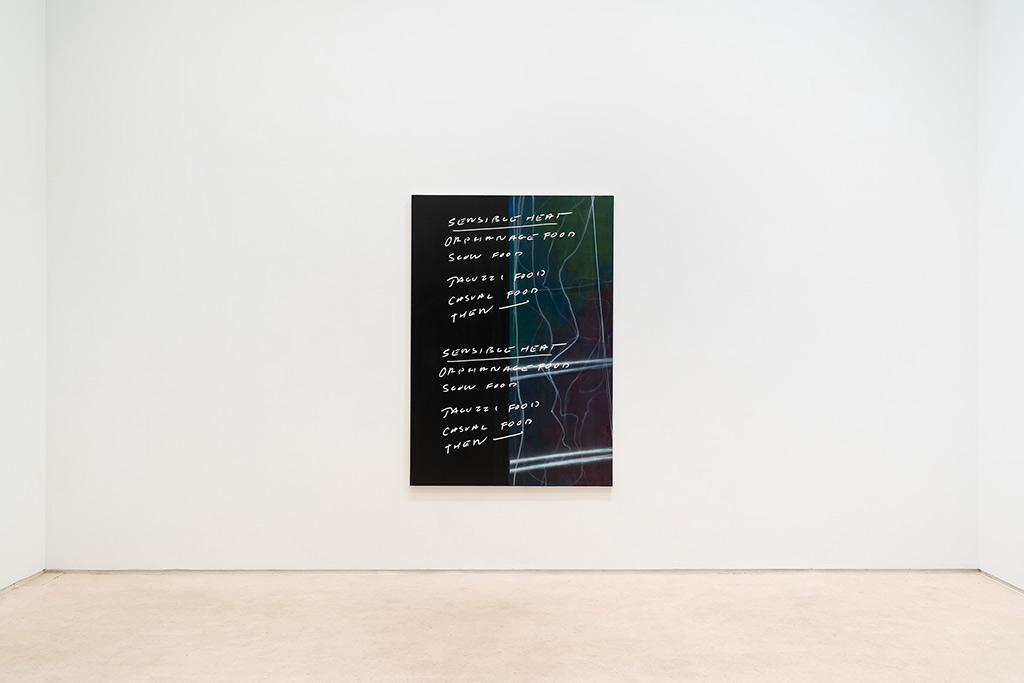
This ninth iteration of the exhibition began with a suite of drawings from 2008 by Raha Raissnia, and was followed by a stamped painting on ceramic plaster panel by Florian Pumhösl. The third work in the show was a multimedia wall mounted object by Flint Jamison. Sam Lewitt’s haunting glass projection work, presented in darkness, constituted the fourth installment in the series. Carroll Dunham’s exuberant, monumental painting, Shape with Entrance (1990), was the fifth work. The exhibition concludes with Blake Rayne’s Untitled painting from 2015.

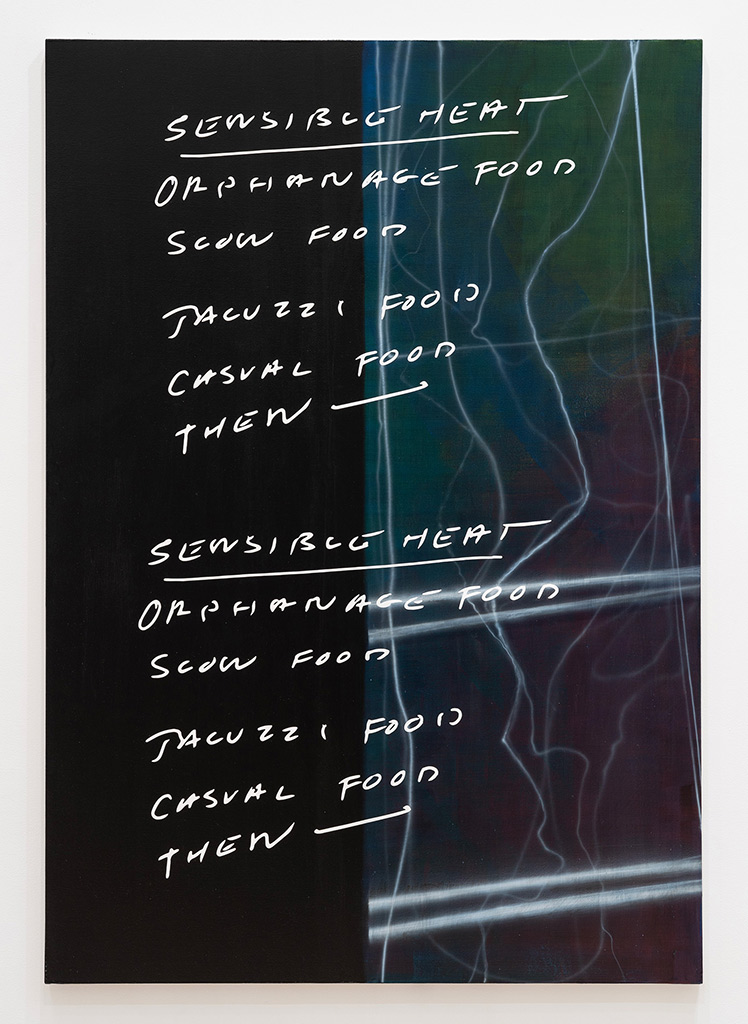
Blake Rayne’s Untitled is part of a series of works that utilize various organizational models (crashing, collapsing, concatenation) and techniques (stenciling, rolling, brushing).
Starting with a serial formation of words generated from notes inputted into a software program, Rayne produced ten cut-up poems. Here, the strategic recuperation of poetry works to confound the demand for a clear, unified voice that the auto-generated data sheet implies. The rhythmic speech of the poem offers an opportunity to momentarily suspend the notion of progress. The materialist poem sits on the place where real meaning might occur.
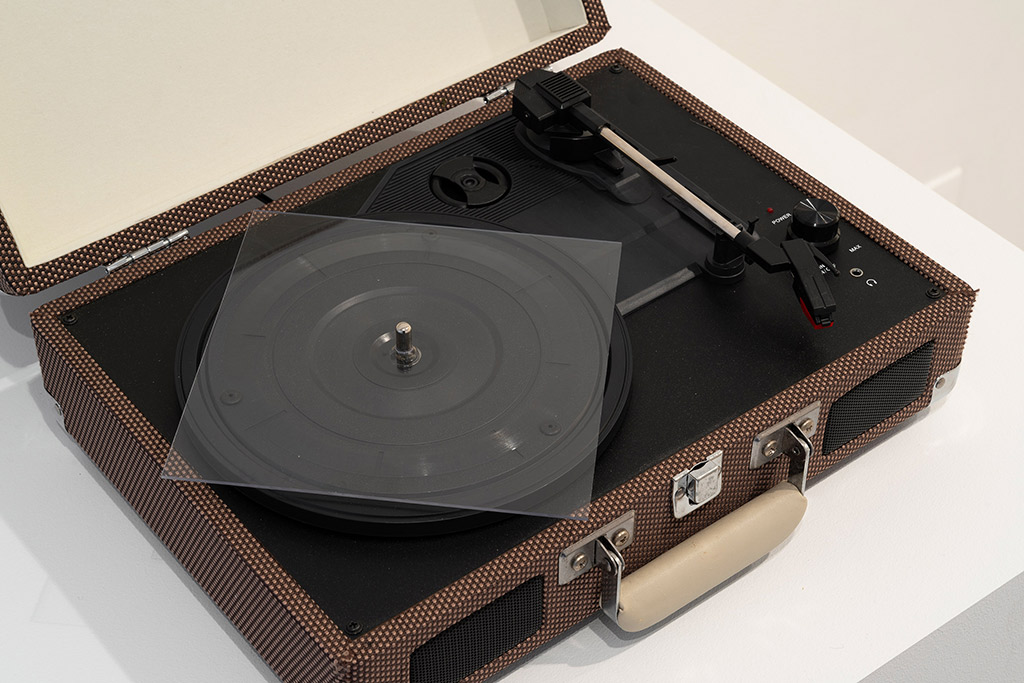
In a final act of translation, a performer recited all ten paintings, or poems, and their recorded voice was transcribed into a notational score. 2:54 Locked Groove is the musical capture of that slip from the data sheet to the poem.
______
WORK 5: CARROLL DUNHAM

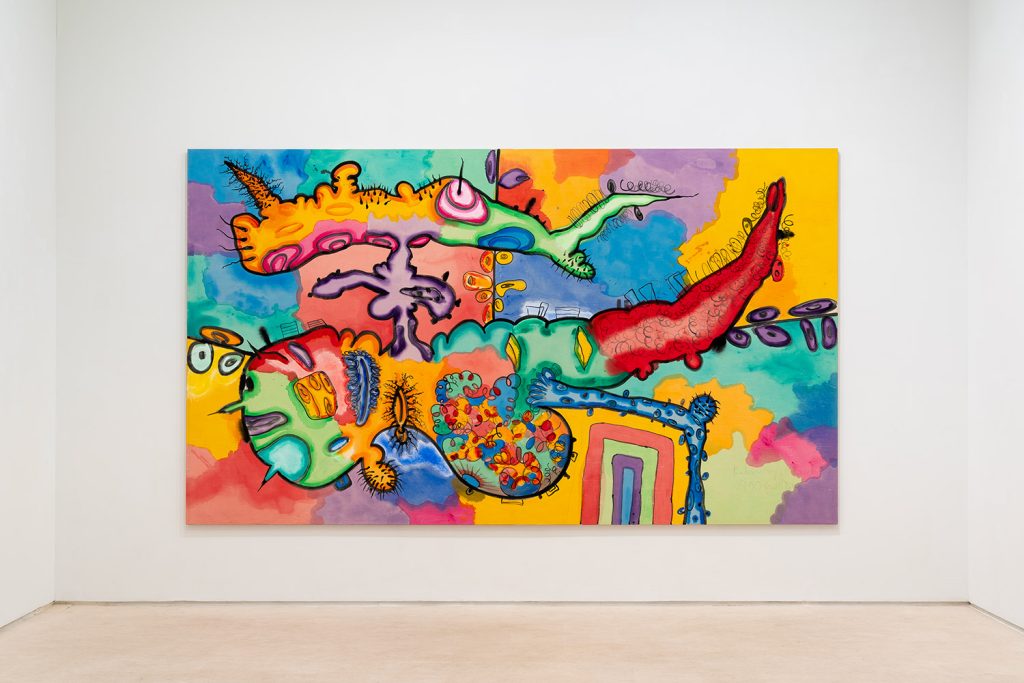
Renowned for his bombastic, polymorphously perverse compositions, Carroll Dunham’s paintings and drawings have confronted and ‘shocked’ their audiences for several decades already. Presented with a seemingly unruly mix of cartoonish figures, delicate doodles, and grotesque genitalia to delve into, the spectator is often left in a state of unease and uncomfortable viewership.
Describing certain fundamental aspects of his practice, the artist recently wrote: “The most telling artifact of my work’s systemic origins is the use of a black outline at the edges of the figures and features being represented; as a young artist, line was my first subject, it has persisted, and it has a mind of its own. I think of my work of the last twenty years as abstraction disguised as figuration.”
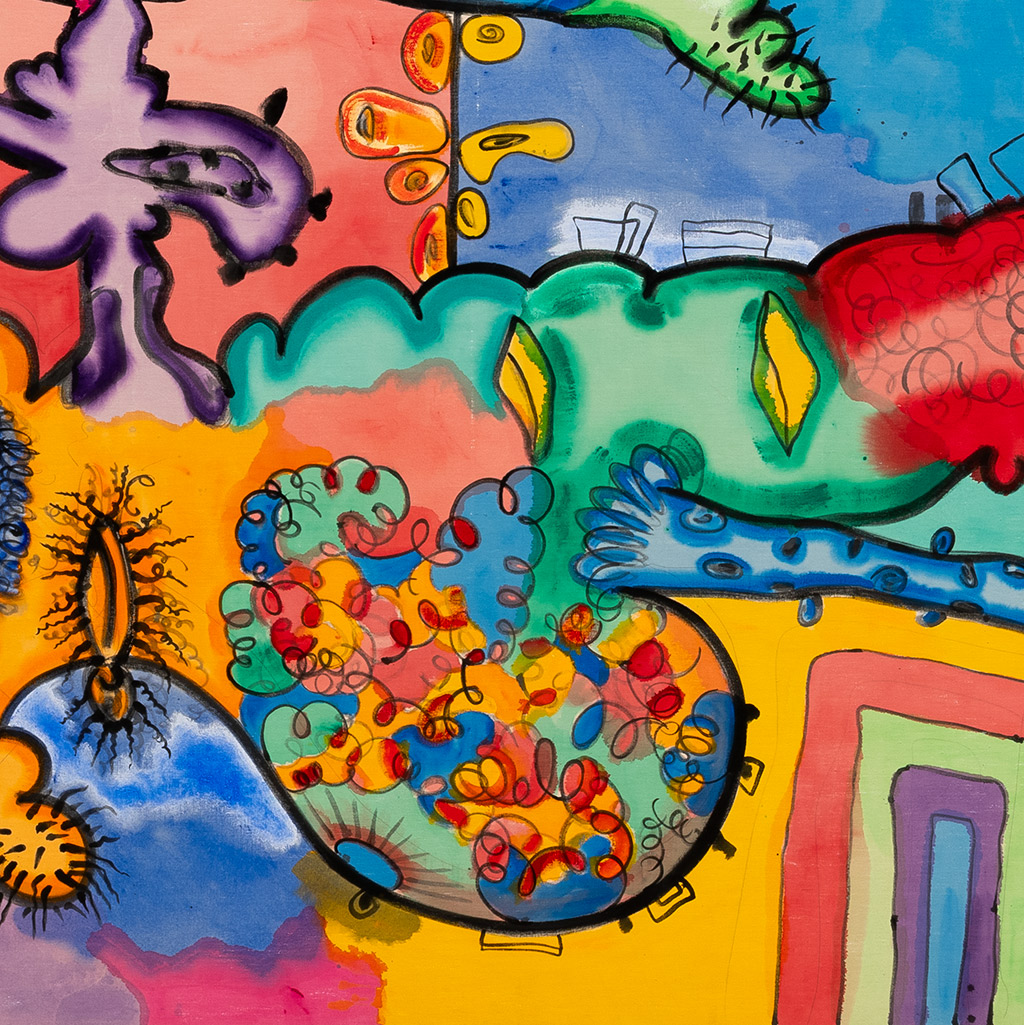
In Shape with Entrance, a major painting from 1990, Dunham floats and balances a humanoid figure at the center of the horizontal picture. Held up in midair by a creepy, arm-like shape which emerges from the bottom of the composition, the figure is surrounded by clouds of gorgeous colors and connected at the top, as if on life support, to an ambiguous, perhaps aquatic creature.
One of the most striking features of Dunham’s work is that his bizarre, compellingly instinctive imagery manages to appear in such self-assured, well-crafted paintings, works that clearly contain some of the lessons of Abstract Expressionism as well as European modernist art. In his decisively materialist pictures, how you paint is certainly as crucial as what you paint.
______
WORK 4: SAM LEWITT
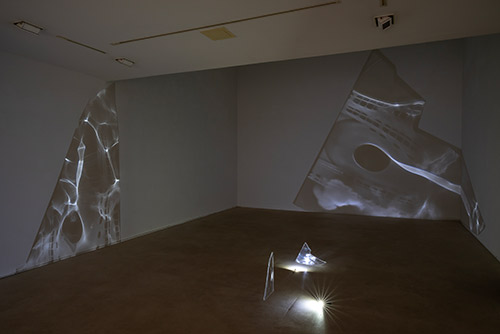
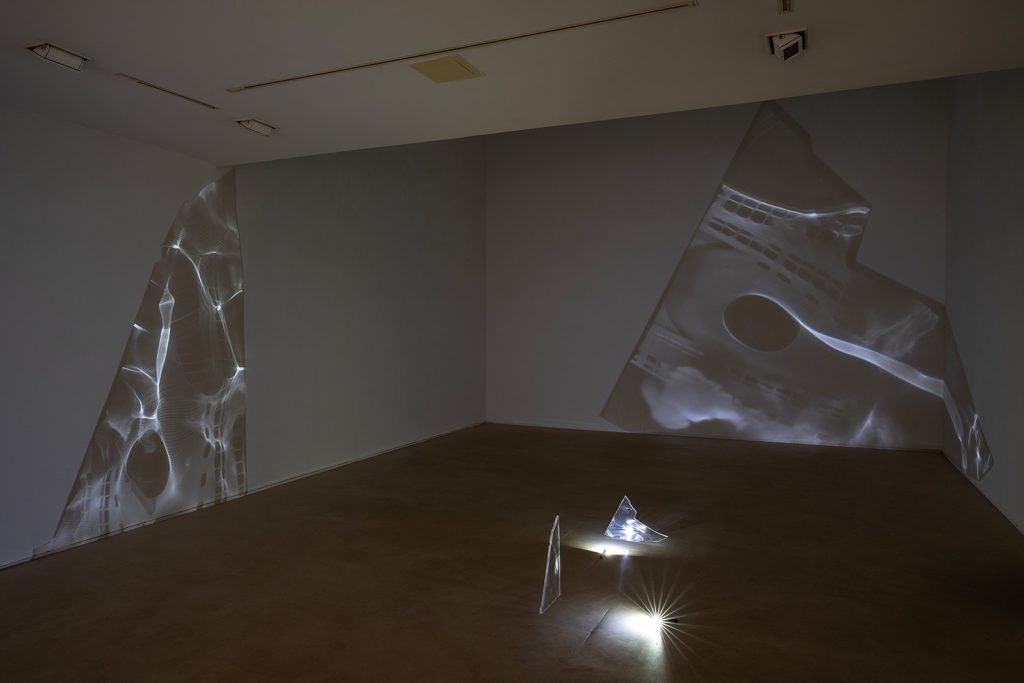
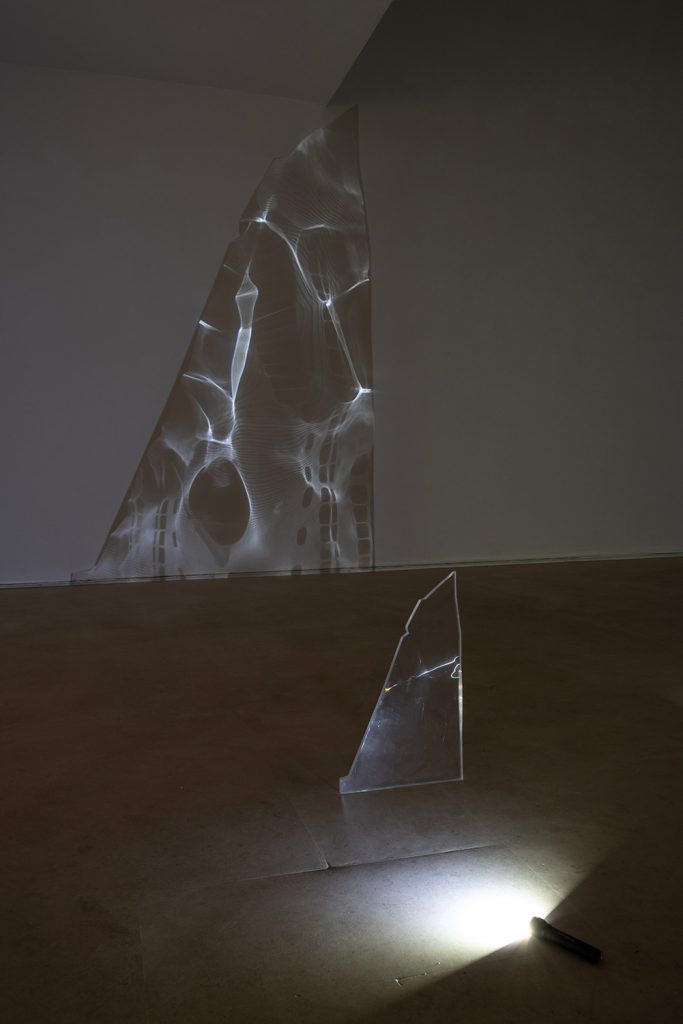
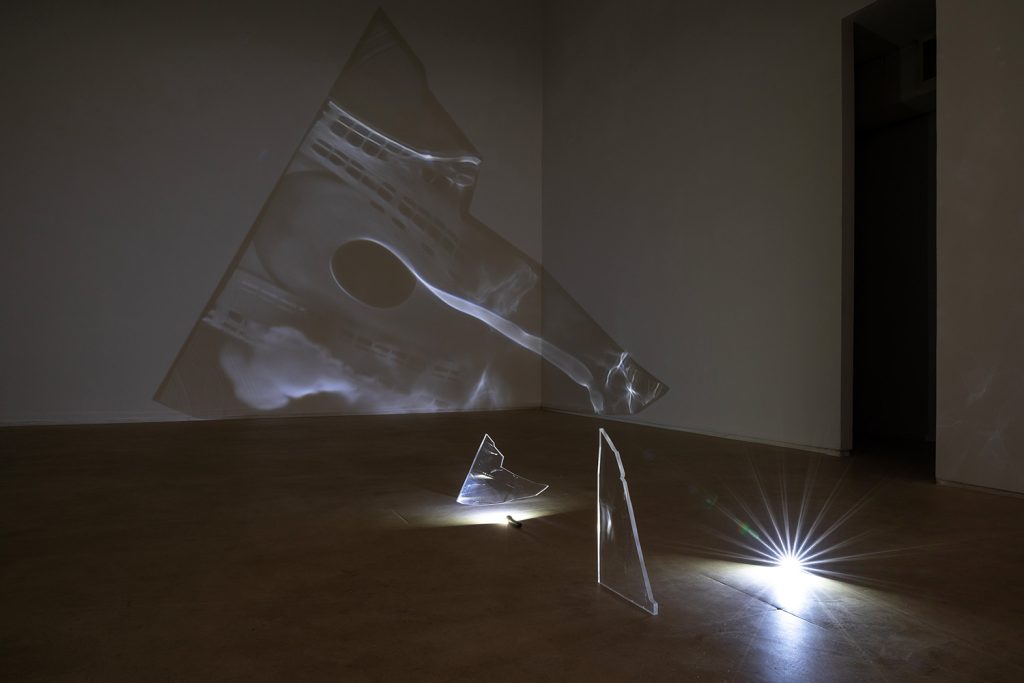
Sam Lewitt’s LENS crystallizes snapshots of a ‘smoke test’ of an unrealized design for a streamlined cruise ship into light shaping surfaces. This unrealized early-twentieth-century design for a cruise ship is the result of an office exercise commissioned by Norman Bel Geddes design associates. The boat was shaped to optimally reduce friction with external environmental conditions. In this presentation it appears through the effluence of its internal combustion. The drift of multiple fires has been simulated in a digital model of its hull using software designed to test fluid dynamics.
Milled shards of a shattered Plexiglas sheet filter the light from a single LED source gathering it into an image through sheer surface variation. Lewitt’s LENS works are physically identical to rippled patterns refracted onto surfaces adjacent to water on a sunny day. The computational reconstruction and control of this phenomenon is being developed as a method of optical watermarking. While the movement of water and light are technically the guiding principle, in optics, this phenomenon is referred to as a “caustic” projection, a word whose original meaning is “to burn.”
______
WORK 3: FLINT JAMISON
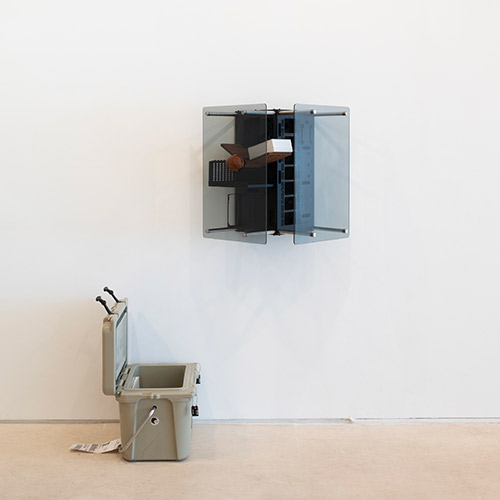
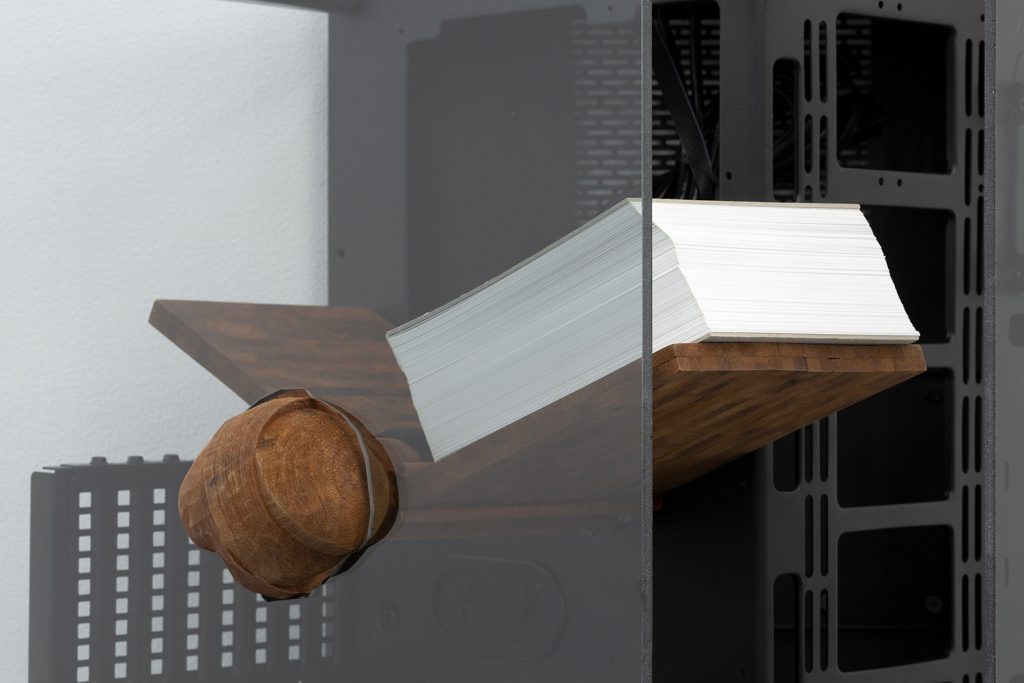
The Game Ready is a must-have for those recovering. It features a dual-action ATX (Active Temperature Exchange) design with two separate internal chambers, one for air and another for water circulation. This design enables the simultaneous delivery of compression and cold therapy throughout the interface, simultaneously helping with the reduction of swelling and the stimulation of blood flow. The Game Ready also takes advantage of patented internal construction that provides maximum and even fluid flow for efficient, consistent thermal management. Recovering with The Game Ready is for those who are invested in mobility. The Game Ready comes complete with its cooler control unit.
Flint Jamison’s The Game Ready, was first exhibited in Opportunity Zones, his 2019 solo exhibition at Kunst Halle Sankt Gallen, Switzerland. Upon the completion of the exhibition, Jamison built it into an altered protective metal and glass wall-mounted case.
______
WORK 2: FLORIAN PUMHÖSL
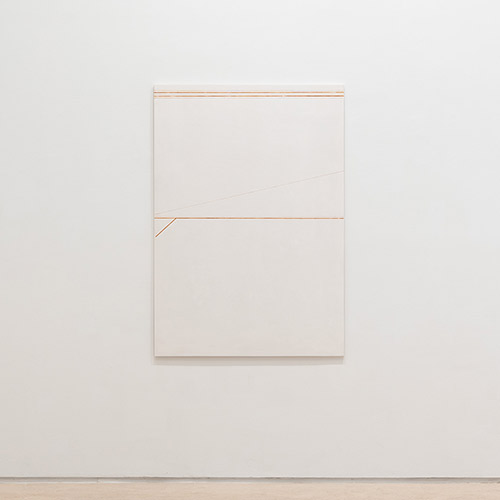
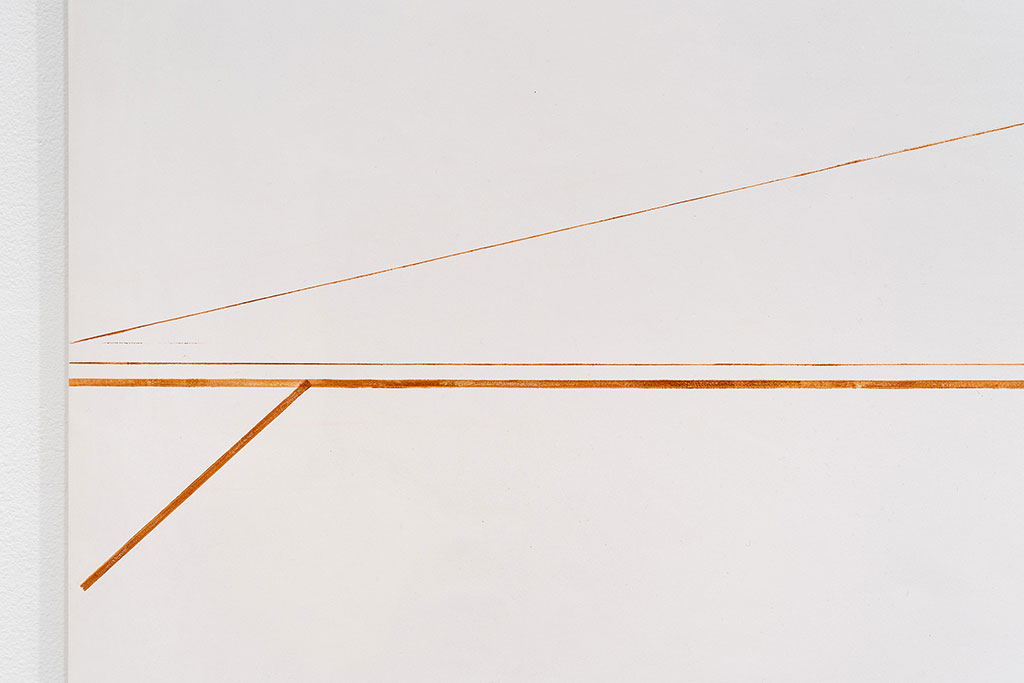
Pumhösl’s painting is derived from a 19th-century rabbinical map (“Eretz Israel,” from Boundaries of the Land by Rabbi Joshua Feiwel ben Israel, Grodno, 1813). The austere motifs, carefully stamped on ceramic plaster panels in oil paint, were produced using a separate rubber cliché for each line in the composition.
The artist’s work can be characterized as an unfolding constellation of references encoded within a visual language that is purely formal. His paintings, films, and installations address the exhibition space as a medium. The mode of production of the series of twelve paintings to which this painting belongs, delicately situated between the proto-mechanical and the precise hand gesture, suggests early 20th-century avant-garde experiments in typography and graphic design. The geometricity of the rabbinical map—an abstracted representation of the imaginary migration routes followed by the twelve Jewish tribes to the promised land—may recall the aesthetic idioms of Russian Futurism and Constructivism. Print publications are further evoked through Pumhösl’s manipulation and exhibition of the map. The diagram was initially divided into twelve equal fragments that were organized in a horizontal array in his show at 88 Eldridge Street, as if pages in a book. This method of display, which the artist considers an interruption of the architectural space, brings to the fore the contradiction between continuity and discontinuity that constitutes the book form and language in general.
The historical significance of Manhattan’s Lower East Side as a prominent first destination for Jewish people settling in the United States adds resonance to exhibiting this work on Orchard Street.
______
WORK 1: RAHA RAISSNIA

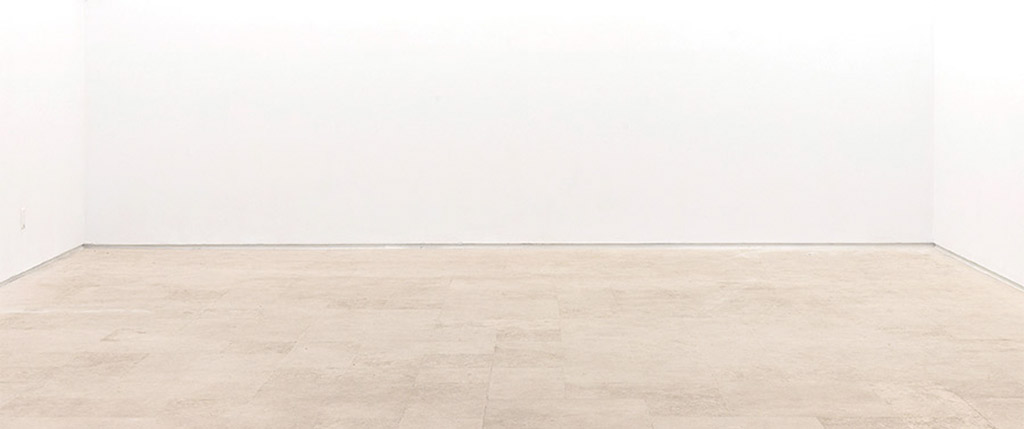
Raha Raissnia’s films, drawings, and paintings are closely imbricated: paintings are contrapuntal compositions catalyzed by film stills, transferred faintly onto the surface of the panel and elaborated upon with oil and gesso. Her films echo this archaeological process, constructed from fragments of earlier work and structured as overlapping pairs of 35mm slide and 16mm film projections. Raissnia’s drawings and collages, likewise comprised of image transfers, with Sumi ink and graphite, examine this relationship of mutual influence. All are guided by the materiality of their media.
While Raissnia’s film works extend time, her drawings on paper seem to define and encapsulate it. Her densely textured work draws in equal measure on the gestural and photographic, the figurative and abstract. As her films render these boundaries ambiguous through layers of manipulation and reference, so too does her two-dimensional work present a world that contains aspects of both but belongs properly to neither. It features passageways to indeterminate locations and irrational architectures. “My paintings brought abstraction to the vision I captured from the world on film, and now the films are bringing elements of reality into my paintings,” Raissnia says. Her viewer is left with the (impossible) task of excavating the two.