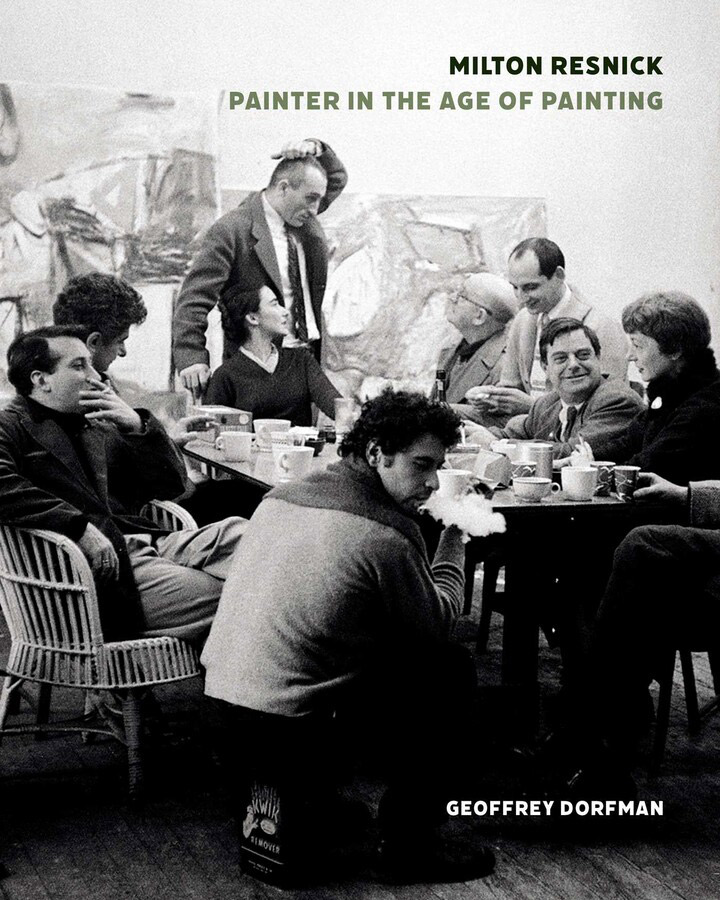
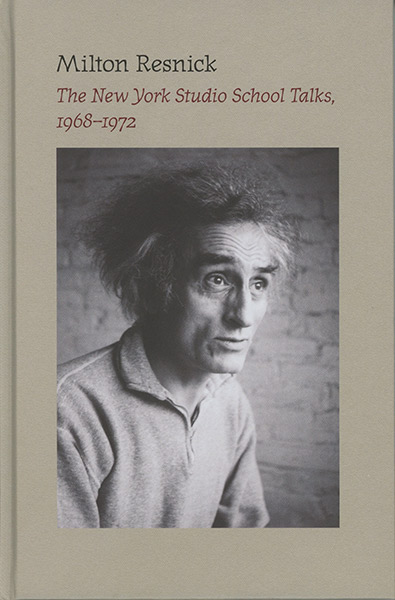
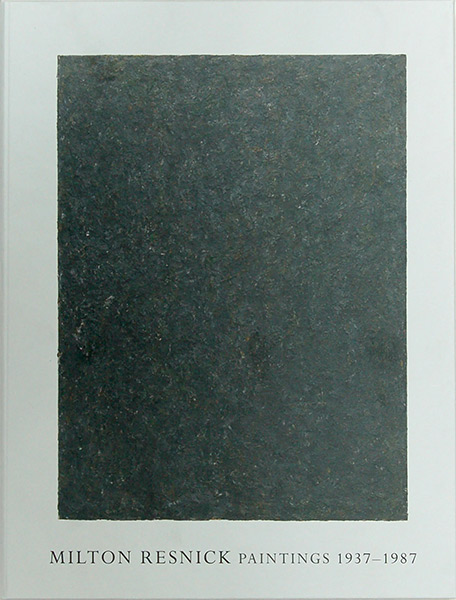
Born in Bratslav, Ukraine in 1917, Resnick immigrated to the United States with his family in 1922. In 1933, he transferred from Pratt, where he studied commercial art, to the American Artists School in order to focus on painting; he graduated in 1937. A first-generation New York School painter, Resnick maintained close friendships with Arshile Gorky and Willem de Kooning, among others. While his early work reflected the tenets of Abstract Expressionism, Resnick ultimately eclipsed more traditional notions of the genre. His transition from explicitly Abstract Expressionist modes to the dense and heavily impastoed canvases of his later years resulted in an intensive exploration of paint’s materiality, leading to the dissolution of line and contour into thick “walls of paint.” In the late 1970s and 80s, Resnick realized his artistic project in which AbEx painting is slowed down and subsumed by the stuff of paint itself. Achieving a unique point of equilibrium between gesture and material, his work reached a limit of this quintessential American idiom. Resnick’s allegiance to the physical properties of paint, its viscosity and “actuality,” was in turn predictive of younger painters like Cy Twombly, Robert Ryman, and Frank Stella, and anticipated artistic movements such as New Materialism today.
read more
Milton Resnick (b. 1917, Braslav, Ukraine; d. 2004, New York) “might qualify as the last Abstract Expressionist painter,” wrote Roberta Smith, for his New York Times obituary. His work is held in numerous public collections in the United States and abroad, including the Museum of Modern Art, Metropolitan Museum of Art, Whitney Museum of American Art, Solomon R. Guggenheim Museum, Brooklyn Museum, and Morgan Library & Museum, New York; National Gallery of Art and Smithsonian American Art Museum, Washington, D.C.; Walker Art Center, Minneapolis; Berkeley Art Museum and Pacific Film Archive; Cleveland Museum of Art; Nelson-Atkins Museum of Art, Kansas City; Princeton University Art Museum; Modern Art Museum of Forth Worth; Milwaukee Art Museum; Wexner Center for the Arts, Columbus; Contemporary Arts Museum Houston; National Gallery of Canda, Ottawa; National Gallery of Australia, Canberra; and Malmö Konsthall, Sweden.